
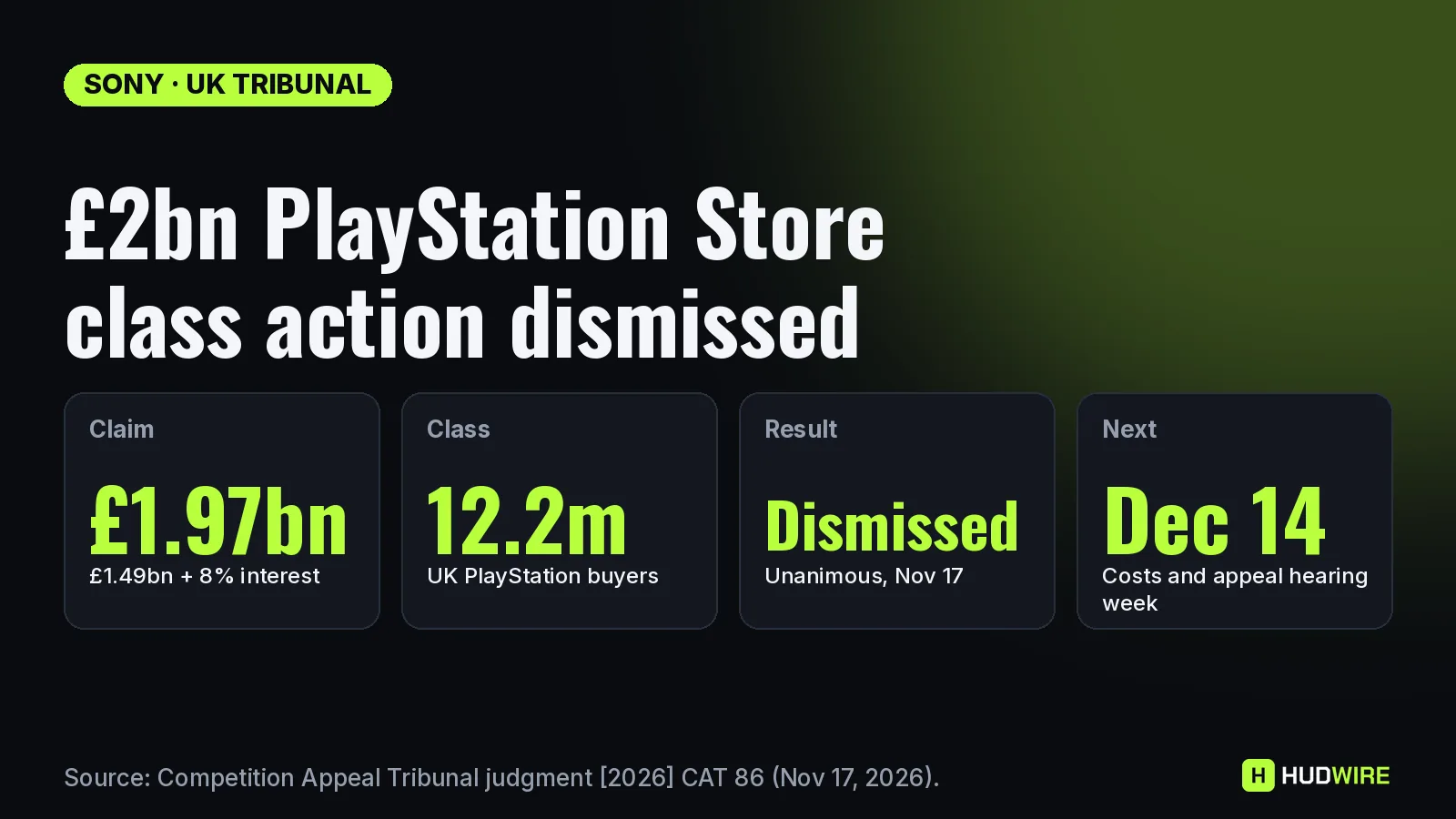
Sony has won the £2 billion UK class action over PlayStation Store prices. On November 17, 2026, the Competition Appeal Tribunal (CAT) dismissed the claim brought by consumer advocate Alex Neill for about 12.2 million UK PlayStation users “in its entirety”, in a unanimous judgment. That means no compensation for players. The case is not quite over: a hearing in the week of December 14 will deal with costs and any request for permission to appeal. Here is what was claimed, why it failed, the numbers in the judgment, and what it means if you buy games on PS5.
Last checked on November 18, 2026. Official Facts below come from the tribunal’s judgment, Alex Neill Class Representative Ltd v Sony [2026] CAT 86, which we read directly, and from Brick Court Chambers (Sony’s counsel). Statements are from Courthouse News and ICLG News.
What the claim said
The claim, filed in August 2022, said Sony abused a dominant position in the sale of digital PlayStation games and add-on content in the UK. It covered digital purchases from August 19, 2016 (August 19, 2017 in Scotland) to February 12, 2026. It made two kinds of allegation:
- Locking out rival stores: exclusive dealing, tying the PS Store to the console, and refusing third parties who wanted to sell digital content on PlayStation.
- Overcharging: an excessive and unfair margin on digital sales. The claim said prices would have been about 20% lower with competition.
It sought about £1.490 billion in damages plus 8% simple interest, about £1.971 billion in total. When the CAT certified it in November 2023, it was valued at up to £5 billion.
Why the tribunal threw it out
| Question | The claim said | The tribunal found |
|---|---|---|
| What is the market? | Digital PlayStation games and add-ons only | Wrong. The right frame is a systems market where PlayStation competes with Xbox and Nintendo; physical games are likely substitutes |
| Is Sony dominant? | Yes, in PlayStation digital sales | Not shown on any relevant market |
| Shutting out rival stores? | Exclusive dealing, tying, refusal to supply | Would fail even on the claim’s own market: the 20% price gap was not made out, and opening PlayStation to other stores raised unresolved security issues |
| Excessive prices? | Sony’s margin is excessive and unfair | Not shown to be excessive, and not apparent it is unfair, measured across the whole PlayStation system |
Official The key line: the tribunal concluded that “competition and rivalry at the system level do provide an effective means to regulate pricing and competitive conduct in the aftermarket”. In plain terms, Sony sells consoles cheaply and earns money back on games, and the tribunal said you cannot judge the store’s margin while ignoring the console it helps pay for. The claimant had no fallback case on that wider market, and accepted in closing that the claim would fail if the tribunal took that view.
The numbers in the judgment
| Figure | What it is | Source |
|---|---|---|
| About 30% | The margin Sony targets on the retail price of digital games on the PS Store | Judgment, para 68 |
| 20-23% | What physical retailers generally keep from a game’s retail price (expert evidence) | Judgment, para 69 |
| About 20% | How much cheaper the claim said digital content would have been. Rejected | Judgment, paras 9-10 |
| £1.490bn / £1.971bn | Damages sought, without and with 8% interest | Judgment, para 11 |
| 12.2 million | UK consumers in the class | Judgment, para 1 |
Our math Spread across 12.2 million people, £1.971 billion works out to about £162 each on average (£122 without interest). Real payouts would never have been equal, and now there are none. For a sense of scale on a single purchase: GTA 6 Standard is £69.99 on the UK PS Store (see GTA 6 price). If Sony’s 30% target applied to it, that would be about £21 of the price; the claim’s 20% cut would have made it about £56. Sony’s actual terms for any single game are confidential, so this is an illustration only.
The disc twist
Part of the tribunal’s reasoning is that physical games competed with the PS Store. After the trial, the judgment notes, the claimant told the tribunal that on July 1, 2026 Sony had announced new PlayStation games would not be released on physical discs from January 2028. The claimant argued this showed discs were never a real constraint. The tribunal said that is “well beyond the claim period” and that, if anything, a legitimate concern would be that ending discs “eliminates a competitive constraint on Sony from independent retailers and allows Sony to increase digital pricing once that constraint has gone”. Official That is the tribunal’s own wording; it made no finding about prices after 2028.
Why Apple lost a similar case and Sony did not
In Kent v Apple [2025] CAT 67, a different CAT panel found in October 2025 that Apple had abused its dominance over iOS app distribution and in-app payments, with aggregate damages of about £1.5 billion (Monckton Chambers). Our reading of the two judgments: Apple was judged on its own iOS app market, while Sony’s store was judged as part of a console system that competes with Xbox and Nintendo and sells discs through independent shops. That difference in market definition decided the PlayStation case before the other questions were reached.
What Sony and the claimant said
- Sony: “The ruling affirms Sony Interactive Entertainment’s business model,” general counsel Stephanie Burns said in a statement reported by Courthouse News.
- Alex Neill: “We are disappointed by the tribunal’s judgment… We argued that PlayStation users were being overcharged for digital games and add-on content because they were effectively locked into Sony’s digital ecosystem,” she told ICLG News.
What it means for PlayStation players
- No payout. The claim is dismissed, so there is nothing to claim and no form to fill in. Be wary of any message asking for your PSN details to “claim” money from this case.
- Prices do not change. The ruling leaves the PS Store as it is, including Sony’s control of digital PlayStation sales.
- Physical still matters, for now. The tribunal treated discs as a real alternative. If you want a disc copy of GTA 6, check what is in the box first: see GTA 6 box with no code.
- Watch December 14. The consequentials hearing that week will deal with costs and any application for permission to appeal.
FAQ
Did Sony win the PlayStation Store class action?
Yes. On November 17, 2026, the UK Competition Appeal Tribunal unanimously dismissed the claim brought by Alex Neill Class Representative Ltd on behalf of about 12.2 million UK PlayStation users.
Will PlayStation users get compensation?
No. The claim was dismissed in its entirety, so no damages were awarded. A hearing in the week of December 14, 2026 will deal with costs and any request for permission to appeal.
How much was the PlayStation class action worth?
About £1.49 billion in damages, or about £1.97 billion with 8% interest. It was valued at up to £5 billion when it was certified in November 2023.
Why did the PlayStation class action fail?
The tribunal rejected the claim’s market of PlayStation digital games only. It found PlayStation competes with Xbox and Nintendo as a whole system and that physical games are likely substitutes, so Sony was not shown to be dominant.
What commission does Sony take on PS Store sales?
According to the judgment, Sony targets a margin of about 30% of the retail price on digital games sold through the PS Store.
Can the PlayStation class action be appealed?
The claimant can ask for permission to appeal. The tribunal will hear any such application, and costs, in the week of December 14, 2026.
Keep reading on HUDWire
Image: HUDWire graphic. Checked November 18, 2026.
Sources
- Competition Appeal Tribunal: Alex Neill Class Representative Ltd v Sony, [2026] CAT 86, judgment (Nov 17, 2026)
- Brick Court Chambers: CAT dismisses £2 billion PlayStation class action against Sony (Nov 17, 2026)
- Courthouse News: Sony beats UK gamers’ PlayStation overcharging claim (Nov 17, 2026)
- ICLG News: Sony defeats £2 billion PlayStation class action (Nov 17, 2026)
- Competition Appeal Tribunal: Kent v Apple, [2025] CAT 67
- Monckton Chambers: Class action on App Store succeeds against Apple