
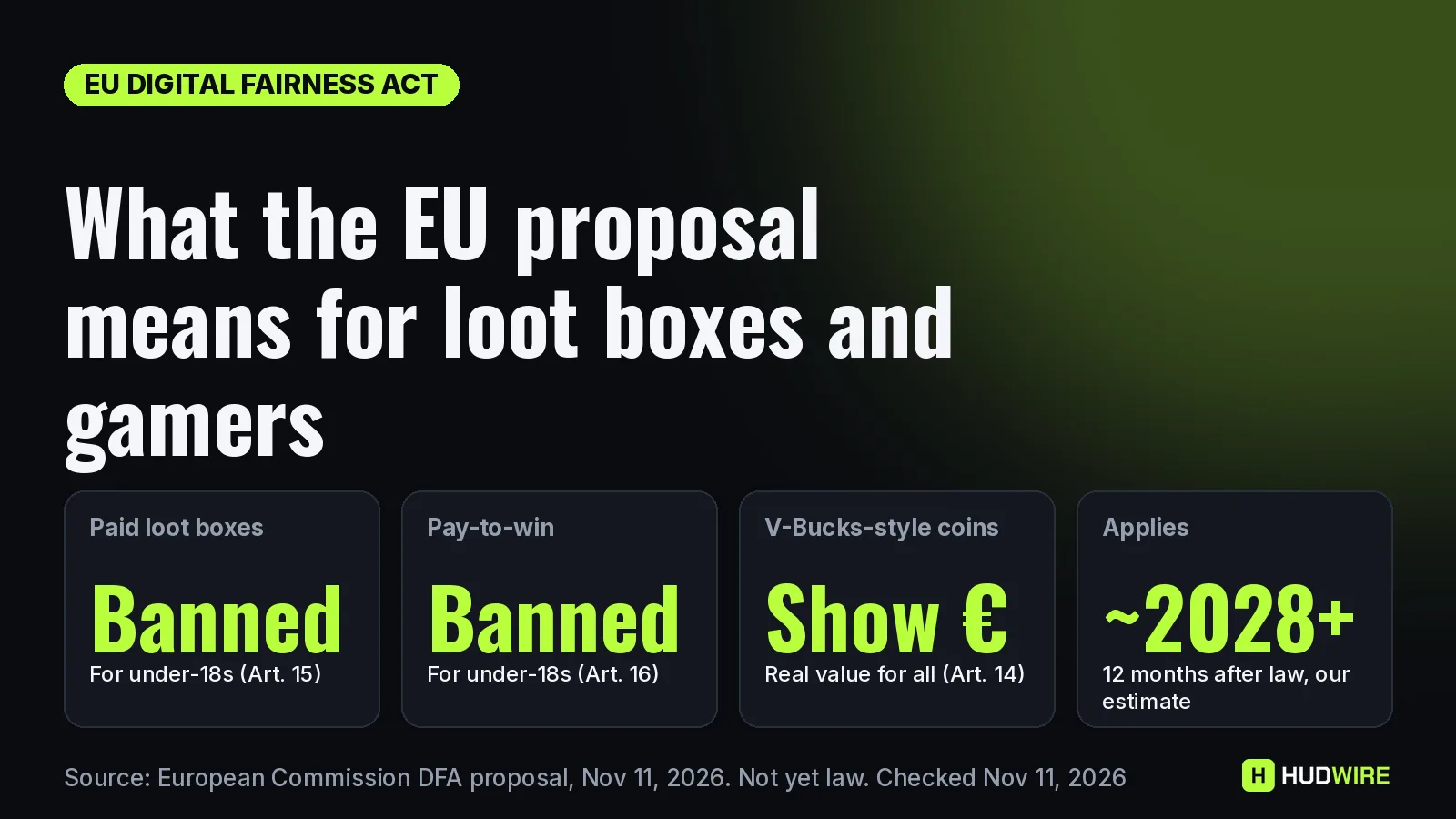
The European Commission formally proposed the Digital Fairness Act on November 11, 2026, and the official text goes further on games than most consumer laws ever have. Paid loot boxes and pay-to-win or pay-to-progress purchases would be banned for under-18s, in-game currencies would have to show their real-money value, and every player would get a switch to turn paid loot boxes off. None of it is law yet: the Parliament and member states still have to agree, and the rules would only apply 12 months after that. Here is what the official proposal says, what changed from the leak, and what it could mean for games like EA Sports FC, Fortnite and GTA Online.
Last checked on November 11, 2026. Official Everything marked Official comes from the Commission’s Digital Fairness Act page, the proposal text (PDF) and its consumer package factsheet, all published on November 11. Reported Industry reactions and the leaked draft details come from the outlets listed in the sources. Our math “Our reading” is how we apply the text to specific games. It is not legal advice, and the final law can change.
What the official proposal changes for games
| Rule | Who it covers | What changes | Article | Status |
|---|---|---|---|---|
| Show the real-money value of items bought with paid currency | Every player | A skin priced in V-Bucks, FC Points or similar must also show its value in the currency you first paid with (euros, for example) | 14(1) | Official Proposed |
| Paid currencies off by default for minors | Under-18s | Paid-for virtual currencies disabled by default; only a parent or guardian can switch them on | 14(2) | Official Proposed |
| Loot box odds and contents | Every player | Games must list what a paid loot box can contain and the probability of getting it | 15(1) | Official Proposed |
| Switch to turn paid loot boxes off | Every player | An “easily accessible” tool to disable paid variable reward systems | 15(2) | Official Proposed |
| No paid loot boxes for minors | Under-18s | Paid loot boxes, card packs or wheels of fortune may not be offered to minors | 15(3) | Official Proposed |
| No pay-to-win or pay-to-progress for minors | Under-18s | Purchases that are, or are presented as, necessary to progress or win may not be offered to minors | 16 | Official Proposed |
| Option to turn off addictive features | Adults | Tools to disable features such as login-streak penalties and notifications unrelated to your activity | 17 | Official Proposed |
| Ban on dark patterns | Everyone | Interfaces that “materially distort” decisions are banned, plus a blacklist (fake scarcity, for example) | 10, Annex I | Official Proposed |
Official The proposal defines a minor as anyone under 18, “irrespective” of national rules. It defines paid loot boxes (“paid-for variable reward systems”) as virtual items “offering random rewards or variable odds” bought with real money or with paid-for virtual currency. Recital 63 names “loot boxes, wheels of fortune, or collectible card packs” as examples. Loot boxes you can only earn by playing are not covered by the minors’ ban, because the definition only covers paid ones.
How does a game know you are a minor?
Official The child rules apply when a game is “directed at minors” or when the company is “aware with reasonable certainty” that a player is a minor. The proposal says a game counts as directed at minors when it has an age rating, including a PEGI rating, “that indicates that the product’s use is appropriate for persons under the age of 18”. It also says that if your account lets the company work out you are a minor, the company is treated as knowing. Marketing aimed at children (characters, influencers, music) also counts as an indicator. Companies are not required to collect extra personal data to check ages.
Our math In practice that means almost every PEGI 3, 7, 12 and 16 game with paid loot boxes or a paid currency is in scope for the child rules, while PEGI 18 games are mainly affected by the rules for everyone, plus any accounts the company knows belong to minors.
Official text vs the leaked draft
| Point | Leaked draft (Nov 10) | Official proposal (Nov 11) |
|---|---|---|
| Paid loot boxes for minors | Banned | Banned (Art. 15(3)) |
| Pay-to-win / pay-to-progress for minors | Banned | Banned (Art. 16) |
| Paid currencies for minors | Off by default, parent approval | Same (Art. 14(2)) |
| Real-money value of currency purchases | Required | Required (Art. 14(1)) |
| “25% of the audience are minors” test | Reported in the draft’s recitals | Not in the published text we checked; PEGI under-18 ratings and account data are the indicators |
| Fines | Up to 6% of global turnover | Member states: maximum fine of at least 4% of national turnover; Commission: up to 6% of worldwide turnover |
| When it applies | Not stated in reports | 12 months after entry into force (Art. 40) |
Reported The leaked draft was first published by Contexte and reported by Mobilegamer.biz and PocketGamer.biz on November 10. Official We searched the official proposal for the 25% audience threshold and did not find it.
What it could mean for popular games
Our math Our reading of how the proposed rules would apply in the EU if they passed unchanged. Ratings are PEGI.
| Game (PEGI) | What it sells | Likely effect for under-18s | Likely effect for adults |
|---|---|---|---|
| EA Sports FC Ultimate Team (3) | Paid player packs, FC Points | Paid packs off the table; FC Points off unless a parent enables them | Pack odds shown (already the case), option to disable paid packs, euro value next to items |
| Fortnite (12) | V-Bucks, item shop (direct purchases) | V-Bucks off by default, parent approval to enable | Euro value shown next to V-Bucks prices |
| Roblox (7) | Robux, some paid random items in experiences | Robux off by default for minors; paid random items not offered | Real-money value shown; tools to disable paid random items |
| Mobile gacha games (12-16) | Paid summons | Paid summons not offered to minors | Odds plus a switch to disable paid summons |
| GTA Online / GTA 6 Online (18) | Shark Cards buy GTA$ | PEGI 18 game: mostly affects accounts known to be minors | GTA$ prices must show their real-money value |
Our math The biggest change for adults is the price label. Today a GTA Online car or a Fortnite skin is shown only in GTA$ or V-Bucks. Article 14 would require the corresponding money value too. Rockstar has not said how GTA 6’s online mode will be monetised (see what is confirmed about GTA 6 Online), and GTA 6 is rated PEGI 18 (age ratings).
When would this actually happen?
| Step | Date | Status |
|---|---|---|
| Commission proposal published | November 11, 2026 | Official |
| European Parliament and Council negotiate and adopt | Not scheduled; EU laws often take 1.5 to 3 years | Our estimate |
| Published in the Official Journal, enters into force | 20 days after publication | Official Art. 40(1) |
| Rules start to apply | 12 months after entry into force | Official Art. 40(2) |
| Earliest realistic date for gamers | Around 2028 or later | Our estimate |
Official As a Regulation, the DFA would be “directly applicable in all Member States” (Article 40). Reported It would replace the 2005 Unfair Commercial Practices Directive with one EU-wide rulebook, and it still has to pass the Parliament and Council, as Digital Watch and The Next Web note. Our math Nothing changes in your games this year, and the text will very likely change during negotiations.
What the games industry says
Update, November 11 (evening): Official Video Games Europe and the European Games Developer Federation (EGDF) responded with a joint statement headed “The DFA is game over for the European games industry”, calling the proposal “unworkable, unjustified and disproportionate”. Reported UK trade body Ukie backed that position in a statement to PocketGamer.biz. We did not find a separate PEGI statement at the time of writing.
| Industry objection (official statement) | What the proposal says (Official) | Our reading |
|---|---|---|
| The pay-to-win / pay-to-progress ban “lacks clear definitions” and “could cover almost any purchase in a game” | Art. 16 bans offering minors purchases that are, or are presented as, necessary to progress or win | The definition will be the main fight in Parliament |
| Banning “virtually all in-game purchases” for under-18s removes parents’ and teens’ say | Paid currencies off by default, parent can switch on (Art. 14(2)); paid loot boxes and pay-to-win banned for minors even with consent (Art. 15(3), 16) | Parents keep control over currency, not over loot boxes or pay-to-win |
| PEGI ratings “indicate suitability, not target audience” | A PEGI rating below 18 counts as directed at minors | Could push some publishers toward 18+ ratings or age-gated features |
| Real-money price labels on currency could mislead players | Item prices must show their real-money value (Art. 14(1)) | Hard for currencies also earned by playing, as game had warned |
Official The industry statement lists its own counter-proposals: purchases and online chat switched off by default for children with only a parent able to switch them on, clear real-money prices, refunds for unused in-game currency and smaller top-up bundles. Our math The first of these is close to the Commission’s Article 14(2); the real gap is the outright ban on paid loot boxes and pay-to-win for minors. Ukie warned the rules could undermine “parental agency” and asked the UK government not to follow the EU approach.
Earlier reactions:
- Reported Germany’s games association game called the draft “disproportionate and unworkable” and warned of double regulation with the EU Kids Act, per GamesWirtschaft. Managing director Felix Falk said that on social media parents get a say, but “in games the Commission takes that decision away from them” (our translation).
- Reported game argues that showing a euro value for every currency purchase is hard in practice because many currencies can also be earned by playing.
- Reported Before the proposal, Video Games Europe published a joint industry letter asking the Commission for a “proportionate and evidence-based approach” and warning against overlap with the DSA, DMA and GDPR.
- Reported The Socialists and Democrats group in the Parliament welcomed the package and said it will push for a “more ambitious” text, so negotiations will pull in both directions.
What you can do now
- Parents: today’s console and phone parental controls already let you block or cap in-game purchases. Set them up now; the DFA will not apply for years.
- Players: check a game’s published drop rates before buying paid packs. Many big games already publish them in-game or on their websites.
- Everyone: work out the real price of currency bundles yourself. Divide the bundle price by the coins you get, then multiply by the item price.
Key takeaways
- It is a proposal, not a law. Nothing changes in games before 2028 at the earliest, by our estimate.
- For under-18s: no paid loot boxes, no pay-to-win or pay-to-progress, and paid currencies off unless a parent turns them on.
- For everyone: real-money prices next to virtual currency, published odds and a switch to turn paid loot boxes off.
- A PEGI rating below 18 is enough for a game to count as aimed at minors.
FAQ
Is the EU banning loot boxes?
Not for everyone. The Digital Fairness Act proposal of November 11, 2026 would ban paid loot boxes for under-18s and give all players a tool to disable them, plus published odds. It is still a proposal that the European Parliament and Council must approve.
When does the Digital Fairness Act take effect?
There is no date yet. The Commission proposed it on November 11, 2026. Once the Parliament and Council adopt it, it enters into force 20 days after publication and applies 12 months later. By our estimate, that means 2028 or later.
Will Fortnite V-Bucks and FC Points be banned?
No. Paid virtual currencies stay legal, but under the proposal they would have to show the real-money value of what you buy and be switched off by default for minors unless a parent approves.
Does the Digital Fairness Act affect GTA 6 and GTA Online?
GTA 6 is rated PEGI 18, so the rules for minors mostly apply to accounts the company knows belong to minors. The rule to show the real-money value of virtual currency purchases would apply to GTA$ bought with Shark Cards in the EU, if the proposal passes as written.
What counts as pay-to-win under the proposal?
In-game or in-app purchases that are necessary, or are presented as necessary, for progress or success, bought with real money or paid-for virtual currency. The proposal would ban offering them to minors.
What are the fines under the Digital Fairness Act?
Member states would have to allow maximum fines of at least 4% of a company’s turnover in the countries concerned for widespread infringements, and the Commission could fine up to 6% of worldwide annual turnover in cases it investigates.
Keep reading on HUDWire
Sources
- Mobilegamer.biz: trade bodies slam the EU’s Digital Fairness Act
- PocketGamer.biz: Ukie warns EU Digital Fairness Act could harm UK games industry (Nov 11, 2026)
- EGDF and Video Games Europe: joint statement on the Digital Fairness Act (Nov 11, 2026)
- European Commission: Digital Fairness Act proposal page (Nov 11, 2026)
- European Commission: Proposal for a Digital Fairness Act, full text (PDF)
- European Commission: Consumer Package factsheet (PDF)
- European Commission: Questions and answers on the Consumer Package
- Digital Watch: Commission publishes official draft Digital Fairness Act
- The Next Web: EU moves to outlaw dark patterns and subscription traps
- GamesWirtschaft: game warns of double regulation (German)
- Mobilegamer.biz: leaked draft takes aim at loot boxes and pay-to-win
Short on time? Swipe through our EU loot box and pay-to-win rules web story. More quick explainers are in our Web Stories.